 Sep 11, 2026
Image-to-Video vs Text-to-Video: Which Controls AI Cinematic Motion Better?
Looking for the best advertising and event management company in Odisha? Call us today at: +91 99373 36692
Artificial intelligence (AI) has now changed the way visual content is created. What once required cameras, actors, locations, lighting equipment, animation teams, and hours of post-production can now begin with something as simple as a text prompt or a single image. Today, AI video generation can turn that idea into a moving sequence within minutes. It has quickly become an important tool for filmmakers, advertisers, content creators, and brands looking to create great cinematic visuals faster.
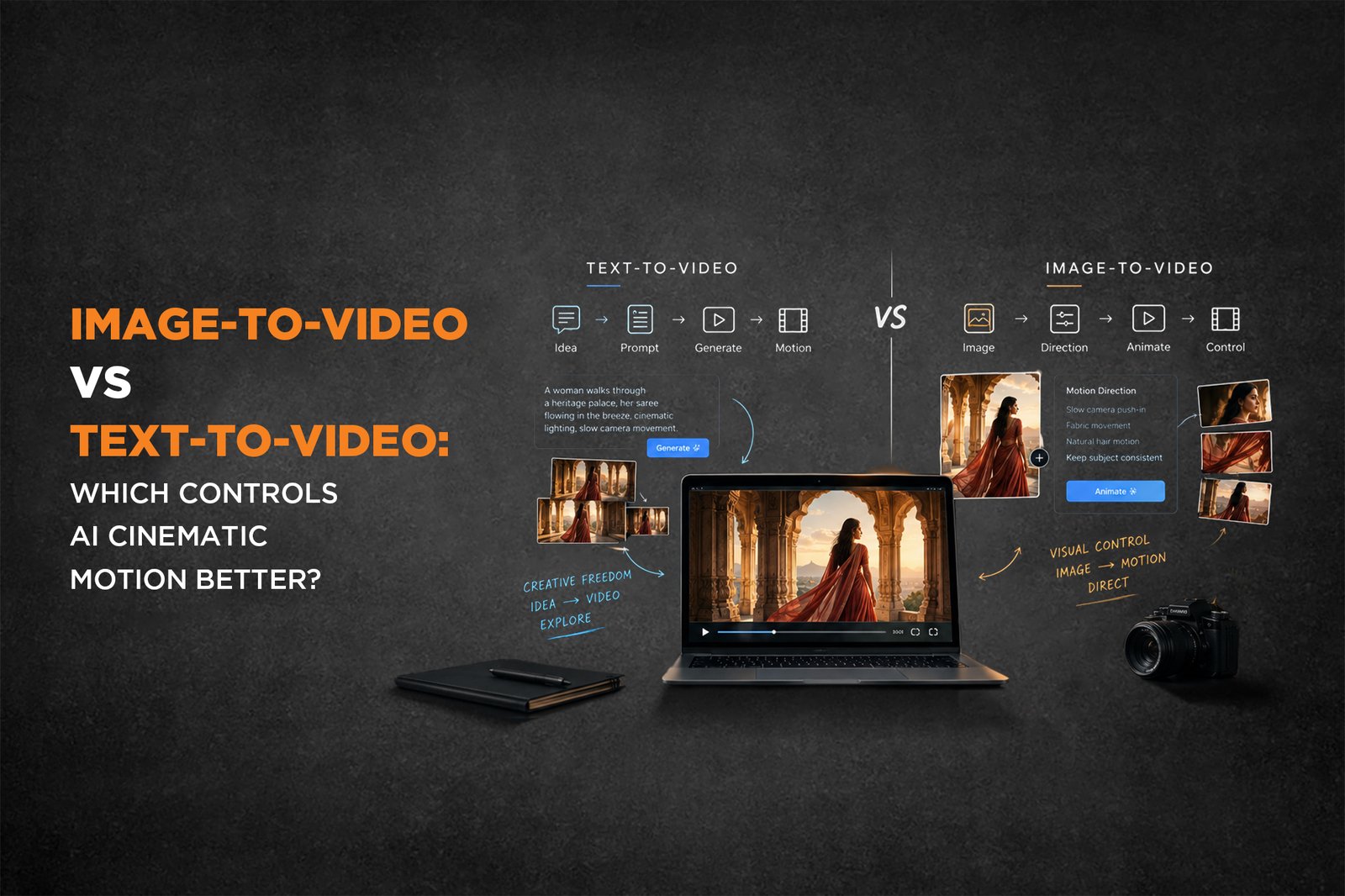
But there is a major creative choice to make. Should you describe the entire scene using text-to-video, or should you first create a still image and then animate it using image-to-video? The answer depends on what you want to control. Text-to-video provides greater freedom at the conceptual stage, while image-to-video offers stronger control over visual consistency, composition, and the starting appearance of a scene. Understanding the difference is essential for anyone using AI for professional video production.
What Is Text-to-Video AI?
Text-to-video technology generates a video directly from a written description. Instead of providing an existing visual, the creator describes the scene, characters, environment, camera movement, lighting, mood, and action through a prompt.
For example, a prompt might describe:
“A luxury car driving through a rain-soaked city at night, cinematic lighting, reflections on the road, slow camera tracking shot, shallow depth of field.”
The AI interprets these instructions and generates a moving sequence. The biggest advantage of text-to-video is creative freedom. You can begin with an idea rather than an existing visual asset. This makes it particularly useful during concept development, mood exploration, visual experimentation, and early-stage storytelling. However, there is a limitation. The AI is making many creative decisions on your behalf. In simple words, you control the instruction, but not always every visual detail.
What Is Image-to-Video AI?
Image-to-video starts with an existing image and transforms it into a moving sequence. The source image establishes the visual foundation, while the prompt tells the AI how that image should move.
For example, imagine you already have a highly detailed image of a jewellery model standing inside a luxurious heritage-inspired setting. Instead of asking AI to recreate the entire scene from text, you can upload that image and instruct the model to create a slow camera push-in, subtle fabric movement, natural hair motion, and gentle jewellery reflections.
Here, the image becomes an anchor. This is one of the biggest advantages of image-to-video generation. The creator already has considerable control over the composition, subject appearance, wardrobe, environment, colour palette, and overall visual identity. The AI's primary task is to introduce motion.

The Real Difference: Creation vs Direction
The fundamental difference between the two technologies can be understood through the idea of direction. With text-to-video, you are primarily creating the visual world through instructions. And with image-to-video, you are directing an existing visual world through motion instructions. This distinction becomes increasingly important as AI-generated content moves from experimentation into professional production.
A creative director may want complete control over the opening frame of an advertisement but still want AI to create the camera movement. In such a case, image-to-video is naturally suited to the workflow. Meanwhile, a filmmaker working on an early concept may want AI to suggest several different visual interpretations. Text-to-video provides greater flexibility for that purpose.
Which Is Better for Advertising?
There is no universal winner. For advertising, this answer often depends on the stage of production. During the concept stage, text-to-video can be extremely useful. A creative team can experiment with several ideas without arranging a shoot. It can help visualize possible campaign worlds, cinematic treatments, environments, transitions, and storytelling approaches.
Once a particular visual direction is approved, image-to-video may become more useful. Suppose a jewellery brand has an approved hero image. The composition, model, jewellery, wardrobe, and setting have already been finalized. Instead of generating another version from scratch, the creative team can use that image as the foundation and create movement around it.
Can Both Technologies Be Used Together?
Absolutely. In fact, combining them can produce a more effective workflow. A creator can begin with text-to-video to explore multiple concepts. Once a preferred visual direction is identified, a selected frame can become the reference image for image-to-video generation.
This creates a systematic process:
“Text-to-video → Explore the idea → Select the visual → Image-to-video → Control the motion”
Such a workflow combines the creative freedom of text prompts with the visual consistency of image references.
Conclusion
Ultimately, everything comes down to one fundamental question: “Are you asking AI to create the scene, or are you asking AI to bring your scene to life?” If the question is specifically about control over cinematic motion, image-to-video generally offers the stronger starting point because the visual foundation is already established.
As AI filmmaking continues to evolve, the real advantage will belong not simply to those who know how to generate videos, but to creators who understand how to control visual continuity, camera language, movement, pacing, and storytelling. Because cinematic AI is not just about making images move; it is about making every movement mean something.